
Desserts
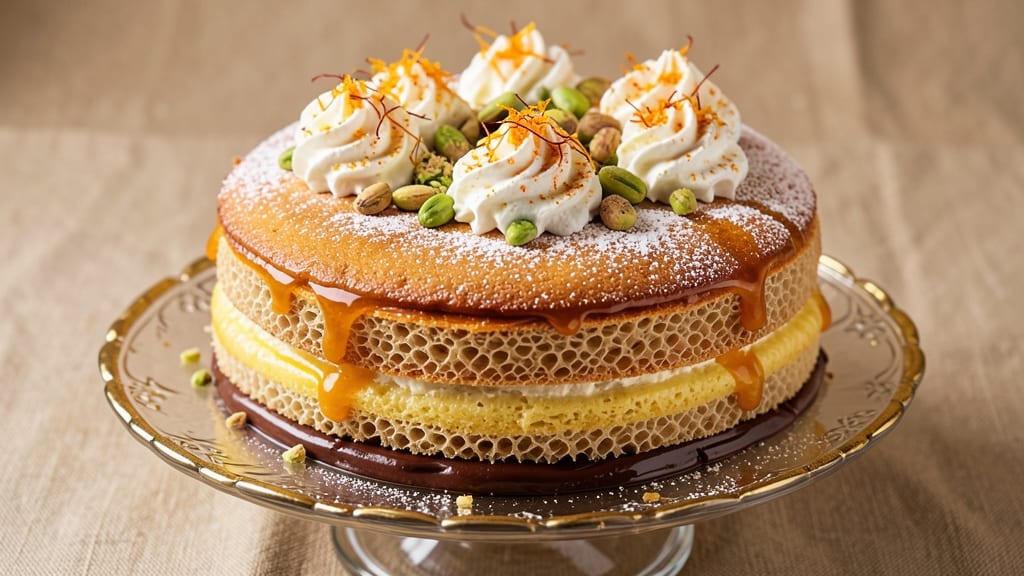
The Arabic saffron cake brings the golden hues and delicate aroma of Middle Eastern tradition to your kitchen, where each slice reveals layers of tender crumb and floral sweetness. 🌟 This recipe captures the essence of Arabic hospitality—luxurious yet approachable—using saffron's rare, golden threads to infuse every bite with warmth and depth. The secret lies in balancing the spice's intensity with buttery richness, creating a cake that's both elegant and comforting.
Traditionally, saffron symbolizes celebration in Arabic culture, gracing special occasions from weddings to religious festivals. Here, it transforms a simple sponge into something extraordinary—fragrant, moist, and studded with citrus zest that brightens the spice's earthy notes. The recipe relies on precise technique: folding egg whites to lighten the texture while keeping the crumb tender, and baking at just the right temperature to preserve the saffron's vibrant color.
What you'll achieve is a cake with a golden bloom at its center, where the saffron's magic shines through like sunlight on a desert horizon. The exterior stays soft and pillowy, while the interior remains moist enough to soak up tea or coffee—perfect for serving with mint tea or strong Arabic coffee. Every slice carries that unmistakable saffron aroma, a scent that instantly transports you to bustling souks and shared meals.
This recipe is designed for both beginners and experienced bakers, with clear steps that ensure success. The ingredients list is straightforward, and the method avoids tricky techniques—just a few folds and a gentle hand. Whether you're baking for a celebration or treating yourself to a taste of tradition, this cake delivers the fragrant spice and golden bloom that define its heritage.
Ingredients for arabic saffron cake
Twelve ingredients transform into a fragrant, golden-hued cake with saffron's signature aroma and citrus brightness.
| Ingredient | Amount | Notes |
|---|---|---|
| All-Purpose Flour 🌾 | 2 ½ cups | Sifted for light texture |
| Granulated Sugar 🍚 | 1 ½ cups | Superfine preferred for smoothness |
| Unsalted Butter 🧈 | 1 cup | Cold, cubed for proper creaming |
| Large Eggs 🥚 | 4 whole | Room temperature for even mixing |
| Saffron Threads 🌼 | ¼ tsp | High-quality, pure saffron |
| Orange Zest 🍊 | 1 tbsp | Freshly grated for vibrant flavor |
| Orange Juice 🍊 | ¼ cup | Freshly squeezed for brightness |
| Baking Powder 🧂 | 1 ½ tsp | Diamond Crystal preferred |
| Salt 🧂 | ½ tsp | Fine sea salt for balance |
| Vanilla Extract 🌿 | 1 tsp | Pure Madagascar bourbon |
| Almond Extract 🌰 | ¼ tsp | For subtle nutty depth |
| Heavy Cream 🥛 | 1 cup | Cold for proper whipping |
| Powdered Sugar 🍚 | ½ cup | For dusting finished cake |
Saffron is the heart of this recipe—prioritize quality threads from specialty stores like Penzeys or Middle Eastern markets. Look for deep red stigmas, free from stems or debris. The orange zest should be freshly grated from organic oranges (the thicker the peel, the more flavor). For butter, Plugrá or Land O'Lakes unsalted work well, but avoid salted varieties. The vanilla extract should be pure bourbon—Madagascar vanilla adds complexity. Almond extract is non-negotiable for that authentic Middle Eastern depth, so don't substitute with vanilla alone.
No saffron? Turmeric at one-quarter teaspoon mimics the golden color but lacks the floral aroma—use sparingly. Substitute orange zest with lemon zest at the same amount, though the flavor profile shifts slightly. For a dairy-free version, replace butter with vegan butter and heavy cream with coconut cream (though texture will differ). The baking powder must be fresh—test with the vinegar test if unsure. Powdered sugar can be omitted if you prefer less sweetness, but the saffron's delicate flavor needs that final touch of sweetness to shine.
Store the cake in an airtight container at room temperature, protected from light, for up to 3 days. For longer storage, wrap tightly in plastic and refrigerate for 1 week. The saffron's aroma intensifies over time, making leftovers even more fragrant. To serve, dust with powdered sugar just before slicing—use a fine-mesh sieve for an even, professional finish. Pairs beautifully with mint tea or Arabic coffee, enhancing the cake's floral notes.
Why You'll Love This Recipe
- No Fussy Steps: I swear by this recipe because it’s just mixing and baking—no creaming butter and sugar until your arms ache. You melt the butter, whisk the eggs, fold in the flour, steep the saffron in warm milk (or water), and boom. Done. The cake’s tender crumb comes from the butter and eggs doing all the work while you sip tea.
- Golden Luxury: That saffron? It’s the star. Just a pinch soaks into the batter, giving it this hint of floral honey and warmth—like sunshine in every bite. Honestly, the first time I tasted it, I thought, "Wait, is this actually cake or magic?" The sugar caramelizes just enough to make it rich without being heavy.
- One-Bowl Crowd Pleaser: This cake is my go-to for brunch, potlucks, or when my in-laws show up unannounced. It’s dense enough to slice neatly (no crumbly mess), and the flavor’s bold enough that even my coffee-loving husband doesn’t roll his eyes when I serve it. Plus, it feeds six easily—no stressing over portions.
- Budget-Friendly Magic: Saffron’s pricey, but you only need a thread or two. The rest? Basic pantry staples. A stick of butter, a handful of sugar, eggs—stuff you’d buy anyway. And the best part? It keeps for days in the fridge, so you’re not scrambling to bake last-minute. My freezer even holds a slice or two for lazy mornings.
Step-by-step instructions for Arabic saffron cake
Mastering this delicate cake requires precision and patience—each step builds the signature saffron aroma and tender crumb.
👨🍳 Step 1: Infuse the Saffron and Prepare the Cream
Steep the 0.25 tsp saffron threads in 0.25 cup orange juice for 10 minutes to extract maximum color and aroma. This infusion is the soul of the cake—don't skip it. Meanwhile, whip the 1 cup cold heavy cream with 0.5 cup powdered sugar until soft peaks form. The cold temperature ensures proper volume without over-whipping, which would make the cream grainy.
I like to use a stand mixer here for consistency, but by hand works too—just be patient. The saffron-infused juice should have a vibrant golden hue; if it's pale, let it steep another 5 minutes. Strain out the threads before using, as even tiny bits can make the texture gritty.
🍳 Step 2: Cream Butter and Sugars to Peak Fluffiness
In a separate large bowl, beat the 1 cup cold cubed butter with 1.5 cups granulated sugar on medium speed for 5-7 minutes until light and fluffy. You're looking for a texture that nearly doubles in volume and leaves faint ribbons when the beaters lift. This step aerates the butter, creating the cake's signature tender crumb.
I press down on the butter mixture with a spatula during the first minute—this prevents it from curdling and ensures even incorporation. The butter should be completely smooth with no visible lumps. If your kitchen gets warm, chill the bowl for 10 minutes before proceeding to maintain proper texture.
👨🍳 Step 3: Incorporate Wet Ingredients with Precision
Add the 4 room-temperature eggs one at a time, mixing just until each is fully incorporated. Then blend in the 1 tsp vanilla extract, 0.25 tsp almond extract, and the strained saffron-infused orange juice. The mixture should be thick but pourable. Here's the thing—don't overmix. You want to maintain air pockets for a light texture, not develop gluten.
Next, whisk together the 2.5 cups sifted all-purpose flour, 1.5 tsp baking powder, and 0.5 tsp salt in a separate bowl. Sift directly into the wet mixture while folding gently with a spatula. This prevents dense pockets and ensures even distribution. The batter should be smooth with just a few flour streaks remaining—overmixing here leads to tough cake.
🥘 Step 4: Fold in the Whipped Cream
Gently fold the whipped cream into the batter using a spatula, working from the bottom up to maintain air pockets. The batter will look slightly curdled, but that's normal—the cream will distribute evenly as you mix. Stop folding when no more streaks of white remain. This step creates the cake's signature moist, velvety texture.
Here's where it gets critical: don't overmix. The moment the batter looks completely uniform is the moment to stop. Overworking it now will collapse those precious air bubbles you've worked so hard to create. Transfer the batter to your prepared cake pan and smooth the top with a spatula.
🔥 Step 5: Bake to Golden Perfection
Preheat your oven to 350°F and bake the cake for 45-50 minutes, or until a toothpick inserted in the center comes out clean. The cake should be golden at the edges but still slightly springy in the middle—it continues cooking as it cools. I like to tent the pan with foil after 30 minutes to prevent over-browning while ensuring even cooking.
This cake has a delicate balance—overbaking makes it dry, underbaking leaves it gummy. The moment it passes the toothpick test is when you should remove it. Let it cool in the pan for 15 minutes, then transfer to a wire rack to cool completely. The cooling process allows the flavors to meld and the texture to set properly for clean slices.
Pro Tips For Making Arabic Saffron Cake
- Bloom the Saffron: Steep those threads in 2 tablespoons of warm milk (not boiling) for 15 minutes before mixing—this unlocks the full golden flavor. I used to just toss it in dry, and the cake always tasted like it was missing something.
- Cream Butter Slowly: Beat the butter and sugar until light and fluffy (3-5 minutes), not just combined. If your mixer’s arm starts sweating, you’re on the right track—this ensures a tender crumb instead of a dense one.
- Don’t Overmix the Batter: Fold in the flour just until combined—lumps are fine, but overworking it turns the cake tough. I learned this after a batch turned out like a brick, and now I stop as soon as the dry bits disappear.
- Test for Doneness Early: The cake pulls away from the edges but still jiggles slightly in the center—that’s perfect. My first batch came out dry because I waited for a toothpick to emerge completely clean (overbaking is the enemy of saffron’s delicate flavor).
Serving suggestions for arabic saffron cake
Tea Pairings
The saffron's floral notes pair beautifully with mint tea, a staple of Arabic hospitality. Brew 2 tbsp fresh mint leaves with 1 cup boiling water and steep for 5 minutes. The cool, refreshing flavor contrasts perfectly with the cake's warm spices, creating a sensory balance. For a stronger match, try Arabic coffee (gahwa)—its cardamom and saffron undertones enhance the cake's depth. 🍵
Fruit Complements
Serve slices with fresh pomegranate seeds scattered on top—their tart-sweet burst cuts through the cake's richness. I also love adding thinly sliced blood oranges on the side, as their citrusy acidity mirrors the orange zest in the cake. For a tropical twist, offer mango slices with a drizzle of honey, which complements the saffron's floral aroma.
Warm Spiced Accompaniments
Warm date syrup drizzled over slices adds a caramelized depth that ties into the cake's spices. For a savory contrast, serve with za'atar-spiced flatbread—the nutty, herby flavors balance the cake's sweetness. I often prepare a small bowl of whipped clotted cream (like labneh) for dipping, which adds a creamy, tangy element that enhances the saffron's floral notes.
Seasonal Variations
In summer, serve the cake chilled with chilled hibiscus tea (karkadé)—its tartness refreshes the palate. For winter gatherings, pair with spiced chai (add 1 cinnamon stick and 2 cloves while brewing) to warm the flavors. The saffron's aroma intensifies when paired with warm beverages, making it ideal for cozy gatherings. ❄️
Presentation Tips
Dust the cake with powdered sugar using a fine-mesh sieve for an even, snowy finish. Arrange slices on a gold-rimmed platter to highlight the saffron's golden hue. Garnish with edible gold leaf for a luxurious touch, especially for celebrations. Serve in small individual portions with tea or coffee to encourage sharing—this cake is meant to be enjoyed communally. ✨
Make-Ahead Serving
Store the cake in an airtight container at room temperature for up to 3 days—the flavors deepen over time. Reheat slices briefly in the oven at 300°F for 5 minutes to restore moisture before serving. For a special touch, brush slices with warmed orange blossom water before dusting with powdered sugar. This technique adds an authentic Middle Eastern aroma that elevates the presentation. 💫
Nutrition facts
Frequently asked questions
Why does this cake need saffron?
Saffron isn't just for color—it's the heart of this recipe! In Arabic cuisine, saffron symbolizes luxury and celebration, adding a delicate floral aroma that transforms ordinary cake into something extraordinary. The threads infuse the batter with their signature golden hue and subtle earthy sweetness, creating that unmistakable Middle Eastern flavor profile. Without it, you'd miss the cake's true soul and cultural essence.
Can I substitute saffron with something else?
You can try turmeric (¼ tsp) for color, but it lacks saffron's floral aroma—your cake will taste different. For flavor, consider orange blossom water (½ tsp) mixed with the orange juice, though the golden hue will be paler. Remember, saffron is irreplaceable for that authentic Arabic touch, but these alternatives work for special occasions when saffron isn't available.
How do I know when the cake is fully baked?
Look for three signs: the edges should be golden brown, the center should spring back when gently pressed, and a toothpick inserted should come out clean. Bake for 45-50 minutes at 350°F, then check at 5-minute intervals—this cake continues cooking as it cools. Overbaking makes it dry, so remove it when it passes the toothpick test but still has a slight bounce in the center.
Why does my cake look dense instead of light?
Overmixing is the most common cause! The batter should be gently folded, not stirred vigorously. Also check your butter—it should be cold but softened, not melted. Another tip: don't skip the saffron infusion step (steep for 10 minutes325°F for 55-60 minutes—the lower temperature gives it more time to rise properly.
Can I make this cake gluten-free?
Yes, but you'll need to substitute the all-purpose flour with a 1:1 gluten-free baking flour blend (like Bob's Red Mill) plus ½ tsp xanthan gum. Replace the orange juice with apple juice and use gluten-free baking powder. The texture will be slightly denser, but the saffron flavor will still shine. For best results, let the batter rest for 15 minutes before baking to help the gluten-free flour hydrate properly.